Velisar · streets and landmarks
Zoom, pan, search named places and follow links between maps.
Reading the city
Velisar developed around a sheltered bend of Caelune’s estuary. Higher ground carries the palace, the older civic buildings and residential streets. Working quays occupy engineered lower banks. Flood protection is maintained as infrastructure; ceremonial confidence is not a substitute for a sound gate.
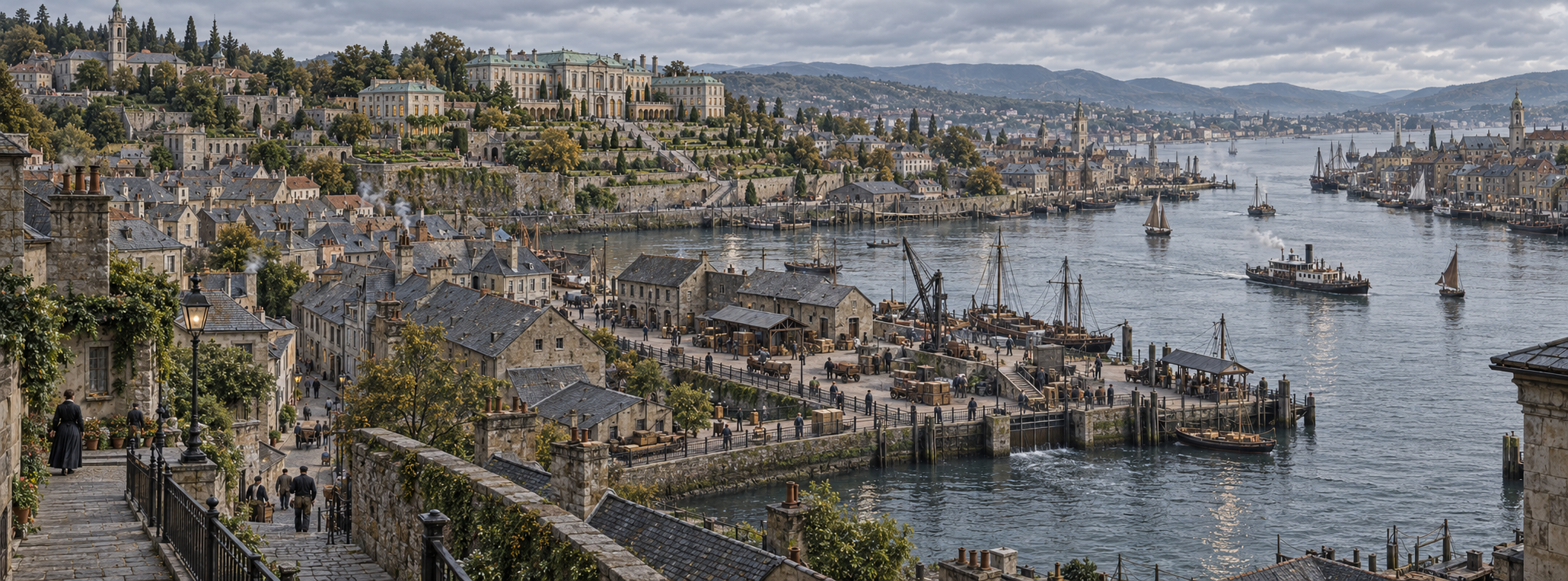
The accompanying plan shows district relationships. It does not supply surveyed street positions, compass bearings or walking times. Its river separates some districts and connects their economies.
Places people use
| District | Everyday function | People and pressures |
|---|---|---|
| Crown Gardens | Royal residence, household offices and service gardens | Ceremony shares space with deliveries, gardening and laundry |
| Petition Square | Public courts, archive and petition office | Visitors need food, translation and lodging while waiting |
| Thread Ward | Clothing trades, rented rooms and repair shops | Edris and Evin live above a cobbler; wages follow work |
| River Quays | Freight, ferries, ovens and covered markets | Early shifts make transport a household necessity |
| East Workshops | Machine repair, technical school and municipal stores | Apprentices learn under accountable supervision |
| Common Gardens | Public recreation, music and shaded paths | Restdays put different trades in the same space |
A day across several households
Before the first petition is heard, tram drivers have carried cleaners towards the civic buildings and bakers have begun unloading fuel. The palace’s public rooms depend on work done at hours most visitors never see. Edris Ro can recognise a reception in the laundry several days before anyone tells him what it celebrated.
School hours overlap most ordinary shifts without fitting all of them. Households rely on relatives, paid care and negotiated hours. A child’s open evening can require a choice about overtime. This is one reason a change to transport or working hours reaches further than the office that approves it.
Capital privilege
Velisar has more advocates, specialist clinicians and libraries than many provincial towns. Residents still compete for appointments and affordable rooms. The city’s advantages are real but not evenly distributed. A provincial visitor may admire its public gardens while calculating how many nights she can afford to remain for a hearing.
Aveline knew the palace routes before she knew most ordinary streets. Her education can take her beyond them without granting automatic familiarity with a city inhabited by thousands of separate routines. The capital is her home; it is not an extension of her household.
The capital beyond the ceremonial approach
Velisar's municipal register estimates about 6.2 million residents, within a commuting region of roughly 11.4 million. The larger figure includes the city; it is not another population to add to it. The capital spreads along engineered estuary banks and inland transport corridors through low industrial roofs, dense residential streets, rail land and municipal gardens. Raised districts possess older masonry and expensive addresses, but desirable lower streets and miserable uphill rooms prevent elevation from serving as a complete social diagram.
Crown Gardens, Petition Square, Thread Ward, River Quays, East Workshops and Common Gardens are useful district names rather than sealed compartments. Workers cross them daily, and the same household may depend on a palace wage, a quay stall and care supplied by a relative elsewhere. Flood embankments and rail reservations interrupt direct routes. The river belongs to the city's connections as much as its separations.
New arrivals often find their first lodging through an employer or a relative. Rooms near reliable tram stops command a premium. A cheaper address can require two fares and a walk through an unlit service road, making the saving conspicuous only on the lease.
Twelve places in the working city
Crown Service Road follows the working side of the royal grounds, carrying scheduled deliveries to household stores. Linen Steps descend towards Thread Ward, with an alternative road route for carts and people unable to use the stairs. Thread Street forms the ward's commercial spine; Cobbler's Court opens from it into mixed workshops and rented upper rooms. Edris's home belongs to this district, without every doorway becoming part of a royal itinerary.
Petition Way climbs from Thread Ward towards the public square. The Public Advocates' Rooms occupy its approach, while the Charter Archive stands on the higher side of Petition Square. Pumpgate Road follows the lower engineered quay district and reaches the Lower Sluice Works. Ferry Court provides a passenger landing and a regulated market, separated from dangerous loading operations. Bench Lane crosses the public edge of Common Gardens. The East Works College stands in East Workshops beyond the main freight approach, linked to the tram network rather than requiring students to walk through active yards.
A practical visit can begin at Ferry Court, follow Pumpgate Road to the ward approach, climb Thread Street and Petition Way, then finish on Bench Lane. Actual access depends on closures; a scenic route is no guarantee that a loaded trolley will fit.
Who keeps the city running
Velisar's municipal council budgets neighbourhood services within provincial law. The Estuary Province coordinates water works and transport across municipal boundaries. Imperial offices administer their own responsibilities, and the royal household controls its grounds and staff. The Capital Coordination Desk exists because a closed road can be the result of any of these authorities and each may initially send the complainant to another.
Trams carry much ordinary passenger traffic, supported by buses, ferries and walking routes. Accessible boarding remains uneven where older stops occupy narrow streets. Freight moves through designated rail and road approaches, with scheduled local deliveries into crowded wards. Orbital passengers and cargo transfer through controlled terminal arrangements outside the ordinary quay system; a harbour landing does not provide a cheap shortcut into space.
The Lower Sluice Works combines gates, pumps, inspection galleries and standby power. Its crews practise emergency closures and clear debris whose owners frequently dispute the cost of removal. Visitors admire the great gates. Operators spend more time worrying about a small mechanism that has begun making a noise nobody has budgeted for.
Employment, injuries and municipal care
East Workshops supplies machinery repair, test assemblies and maintenance skills used by civilian fleets and military contractors. Thread Ward makes and alters clothing, repairs footwear and processes household textiles. River Quays handles food, fuel and regional freight. Palace employment adds a stable institutional customer while imposing ceremonial peaks that exhaust laundries, kitchens and transport staff.
The Quay Injury Clinic treats acute occupational harm and refers severe cases to city hospitals. Workers need documentation for compensation, and casual labourers may discover that the person directing their shift denies employing them. Public advocates help establish the chain of instruction and pay. The work is necessary and slow. A crushed hand does not wait for the correct contractor to acknowledge it.
The city funds schools, public bathing facilities and neighbourhood care centres. Capacity follows neither need nor growth perfectly. Newly subdivided buildings can add dozens of children to a school catchment without adding a classroom. Landlords describe the conversion as more efficient use of space. Teachers eventually find the efficiency sitting on the floor.
Smoke, floodwater and older ground
The estuary carries silt, tidal movement and upstream runoff. Low districts need drainage that continues functioning when the receiving water rises. Polluted sediments from older industry complicate dredging; contaminated material must be handled rather than spread over convenient ground. The cheapest disposal offer often achieves its price by moving the injury outside the buyer's jurisdiction.
Still weather traps local fumes in some industrial corridors. On warned days, schools move activities indoors and street vendors cover goods, although cover alone does not protect the person selling them. Household air filters have running costs. The families most exposed can least afford to keep them operating continuously.
Rats and scavenging birds exploit freight waste, while marsh runners enter disturbed banks during nesting periods. Crews balance pest control against contamination and harm to other wildlife. Flood preparation includes stock protection, evacuation assistance and checks on people unable to use stairs. A household can receive three printed evacuation notices and still have nobody available to carry its oldest resident.
The city after its shift
The Low-Water Fair draws crowds to safe public reaches of the quays and Common Gardens. Licensed food stalls, music, small theatres and amateur exhibitions share space with traders who appear only when enforcement officers are eating. The city's rough humour favours the gap between an official promise and the floor beneath it. A popular puppet magistrate requests documentary proof that the rain has fallen inside his jurisdiction.
Ordinary meals include pies, onions, beans, fish where affordable and stews made to survive reheating. The late-shift ovens near Ferry Court sell discounted portions before closing, producing queues of workers who know precisely how much dignity is worth after midnight. Public halls host court games, dance lessons and union meetings on different evenings; their chairs are rarely comfortable enough for all three.
Keeping Houses organise memorial meals and practical assistance. Secular clubs offer similar companionship without requiring shared belief. Music in Common Gardens belongs among these ordinary supports: an inexpensive place to sit among strangers without having to explain why one has come alone. Velisar contains tenderness without distributing safety evenly. Its pleasures are often most necessary to the people who have the least time left to enjoy them.