Tarsenne · Mercator world chart
Zoom, pan, search named places and follow links between maps.
A world has more than one weather
The word habitable conceals a great deal of expensive work. It may mean a person can survive outside unaided at a particular altitude, or that a settlement can keep a pressure shell functioning, or that a broker has found someone willing to sign the transport contract. Travellers should learn which definition is being used before paying.
Tarsenne’s western mountains, eastern rain shadow, island sounds, monsoon plains and cold southern forests support different ecologies. Caelune’s dense estuary settlements have engineered much of their immediate landscape. Damar’s basin water systems sustain concentrations of people amid colder, drier ground. Pelaset’s coasts favour maritime traffic while storms make its reliability an argument. Nereth’s interior climate is produced by machinery.
The environmental register
These are regional patterns, not a replacement for a local forecast. A safe district can contain an unsafe shaft, enclosed cellar or downwind works yard.
| Environment | Where encountered | Material danger | Necessary local provision |
|---|---|---|---|
| Temperate wet forest | Western Rauth; Caelune uplands | Rot, flood surges, concealed predators, falling limbs | Dry storage, maintained paths, roof inspection |
| Cold fjord and alpine basin | Halvyr and high Valed | Exposure, avalanche paths, isolated winter supplies | Shelters, fuel reserves, local route knowledge |
| Dry rain-shadow basin | Selnic; parts of Damar | Heat stress, dust, salt accumulation, failed water allocation | Shade, treated water, covered stores |
| Monsoon plain | Western Edrava / Orsala | Flood displacement, contaminated wells, vector outbreaks | Raised stores, boat access, functioning drainage |
| Marine archipelago | Veydan; Pelaset coasts | Storm surge, corrosive salt, reef toxins | Forecast signals, harbour refuge, seasonal closures |
| Industrial inversion district | Selected Caelune, Damar and Tarsenne wards | Suspended particulates and corrosive deposition | Filtered indoor refuges, maintenance and emissions control |
| Cold sealed settlement | Nereth | Thin low-oxygen air, extreme cold, pressure loss | Heated pressure shells and redundant life support |
| Saline flats and steppe | Interior Tarsenne | Exposed travel, misleading crusts, sudden dust fronts | Water caches, tested routes, shelters |
| Volcanic ground | Island arcs and mountain margins | Hot gas, ash, unstable crust and polluted drainage | Exclusion zones, air monitoring, evacuation access |
Corrosive rain
The rain that attacks exposed metal and skin belongs to particular industrial and volcanic plumes. It is not every grey cloud. Sulphur-bearing exhaust, reactive dust and wet air combine most dangerously where weather traps emissions close to the ground. A distant ridge may be clear while a valley street remains under a sour yellow mist.
Affected districts publish exposure notices and maintain covered routes, rinse stations and protected waiting rooms. Workers use outer coverings and respiratory protection suited to the local contaminant, supplied and inspected by the works where the law is enforced. An ordinary cloth over the mouth is not a universal answer to gases, particles or oxygen deficiency. Cheap employers prefer universal answers because they fit on one poster.
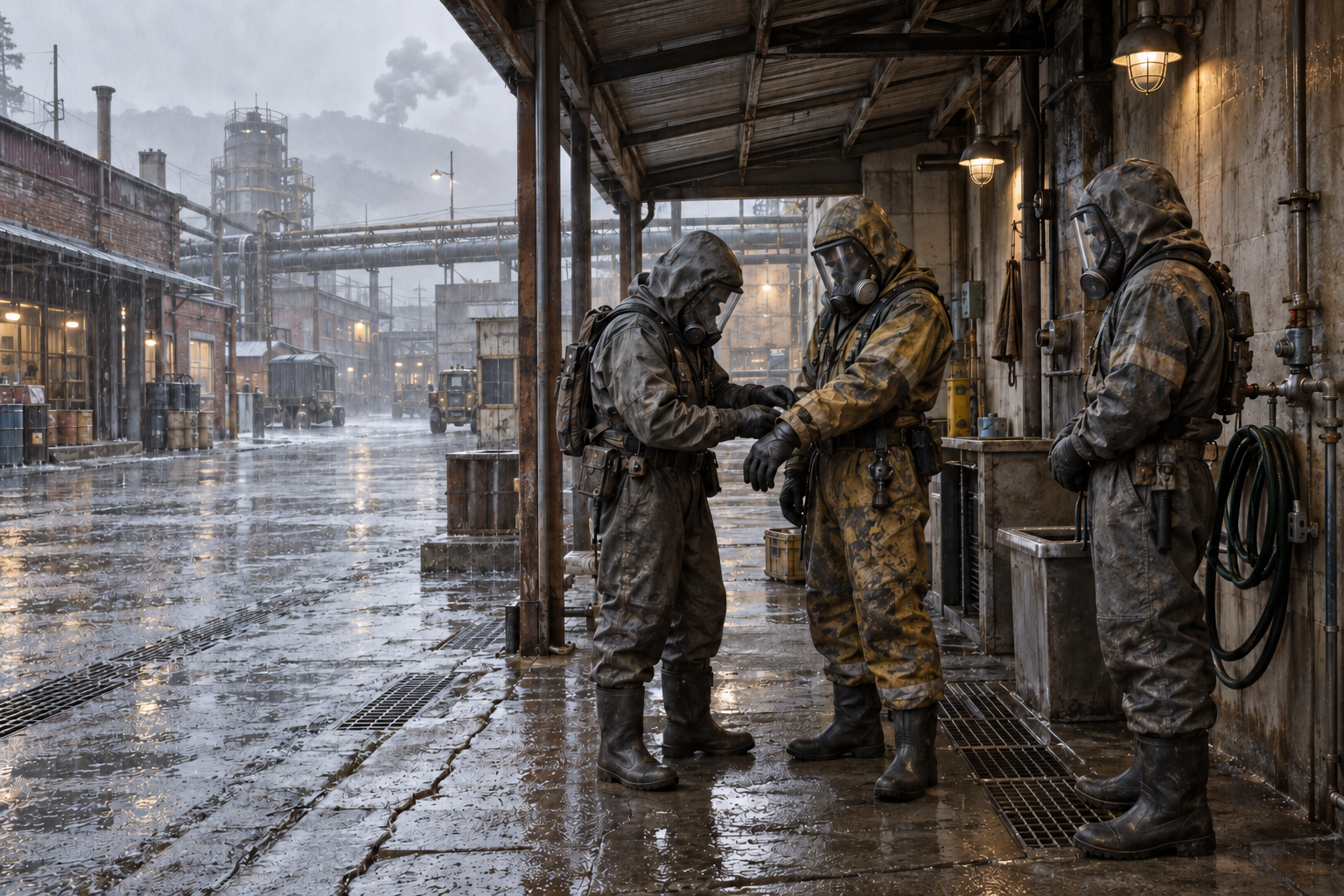
Protective clothing has a working life. Cracked coatings, failed seals and dirty filters become an expense households can postpone only by spending their health instead. Laundry yards, repair shops and schools therefore form part of the environmental infrastructure. Children do not become less exposed because the factory gate is beyond the school boundary.
Water has a memory
Floodwater carries what was stored upstream: manure, fuel, household waste, spores and the remains of containers declared empty on a form. Clear water is not proof of safety. Selnic treats salinity and industrial contamination as separate problems; a process that solves one may leave the other unchanged. Orsalan flood districts keep raised wells and test communal points after inundation.
The distribution of cleaner water reveals power. A court can order a company to repair a poisoned channel; collecting the money and maintaining the substitute supply are further tasks. Compensation paid to registered landholders may leave tenants carrying the containers. In some towns a household’s inherited access is more valuable than the house itself.
Fire, ice and abandoned maintenance
Fire travels through fuel and buildings, not moral categories. A neglected firebreak can make an entire settlement vulnerable while its council debates whether the neglected strip is public land. Cold stores, boilers and district heating also turn maintenance into collective dependence. An unpaid caretaker can be the difference between a winter interruption and deaths reported later as weather-related.
Abandoned works are particularly dangerous because the landscape keeps using them. A blocked culvert becomes a new watercourse; a subsiding slag face changes the drainage; a stopped pump fills a lower street. Salvagers and residents can know these changes better than the office holding the last survey. Their knowledge deserves checking and payment, not automatic dismissal as superstition.
Living with warnings
Warnings succeed when people can act on them. Telling workers to remain indoors means little if absence costs the room they would remain inside. Useful local arrangements include paid shelter periods, accessible refuge keys, transport for people unable to walk and somebody responsible for opening the building outside office hours.
The rim’s ordinary courage is often unphotogenic: a driver completing the refuge run, a neighbour checking a shut door, a mechanic refusing to sign an unsafe release. Councils celebrate such people after a disaster. The more competent councils also budget for their wages before it.