Tarsenne · Mercator world chart · Aunel · stellar system
Zoom, pan, search named places and follow links between maps.
1. Planetary identity and quick reference
On an imperial itinerary, Tarsenne is a destination. On Tarsenne, it is the ground beneath a considerable number of arguments. A North Quay pilot means the coast when she says home; a Halvyri shepherd means the valley whose slopes he can name in fog. The rim describes where their world lies in the galaxy. It does not tell either of them who owns the next field.
Tarsenne is the modern trade spelling of Tarsen, an old coastal expression for a returning shore: land seen again after an offshore passage. The observatory at Vannic put that form on the early navigational sheets. Other languages retain their own world-names, and the antiquity of the coastal word is disputed. No single landing party is credited with creating an inhabited world.
The present reference epoch is Survey Reckoning 683, abbreviated SR 683, before Aveline’s departure. Imperial correspondence for the same period is labelled CR 412. This is an epoch correspondence, not a rule for converting every historical date. Tarsenne’s calendar has twelve numbered months of thirty local days; a local day lasts twenty-six standard hours. Ship clocks and home clocks therefore drift apart unless deliberately reconciled.
| Measure | Reference value | Meaning |
|---|---|---|
| Primary / moon | Aunel / Orris | Amber-white star; one large moon visible without instruments |
| Diameter / surface gravity | About 12,560 km / 0.96 standard | Rounded planetary survey values |
| Surface / ocean cover | About 496 million km² / 69% | Approximately 154 million km² of land |
| Day / orbital year | 26 standard hours / 360 local days | A year contains 9,360 standard hours |
| Axial tilt | About 24 degrees | Strong seasonal contrast away from the equator |
| Population | Estimated 19–24 million | Incomplete, overlapping and differently dated registers; no planetary census |
| Capital / planetary sovereign | None | Capitals belong to countries, not to Tarsenne as a whole |
| Prime meridian | Old Vannic observatory | Survey convention, not a territorial claim |
2. Land, sea and the weather between them
Rauth is the broad northern mainland. Its western uplands intercept moist ocean air. Rivers descend towards the Sedge Coast through wooded valleys, depositing the brown silt familiar at Reedbank. Farther north, repeated glaciation has cut Halvyr’s fjords and steep inland basins. East of the mountain spine, descending air dries the Selnic basin. Snowmelt reaches its reservoirs, but summer rain cannot be assumed simply because the west coast is wet.
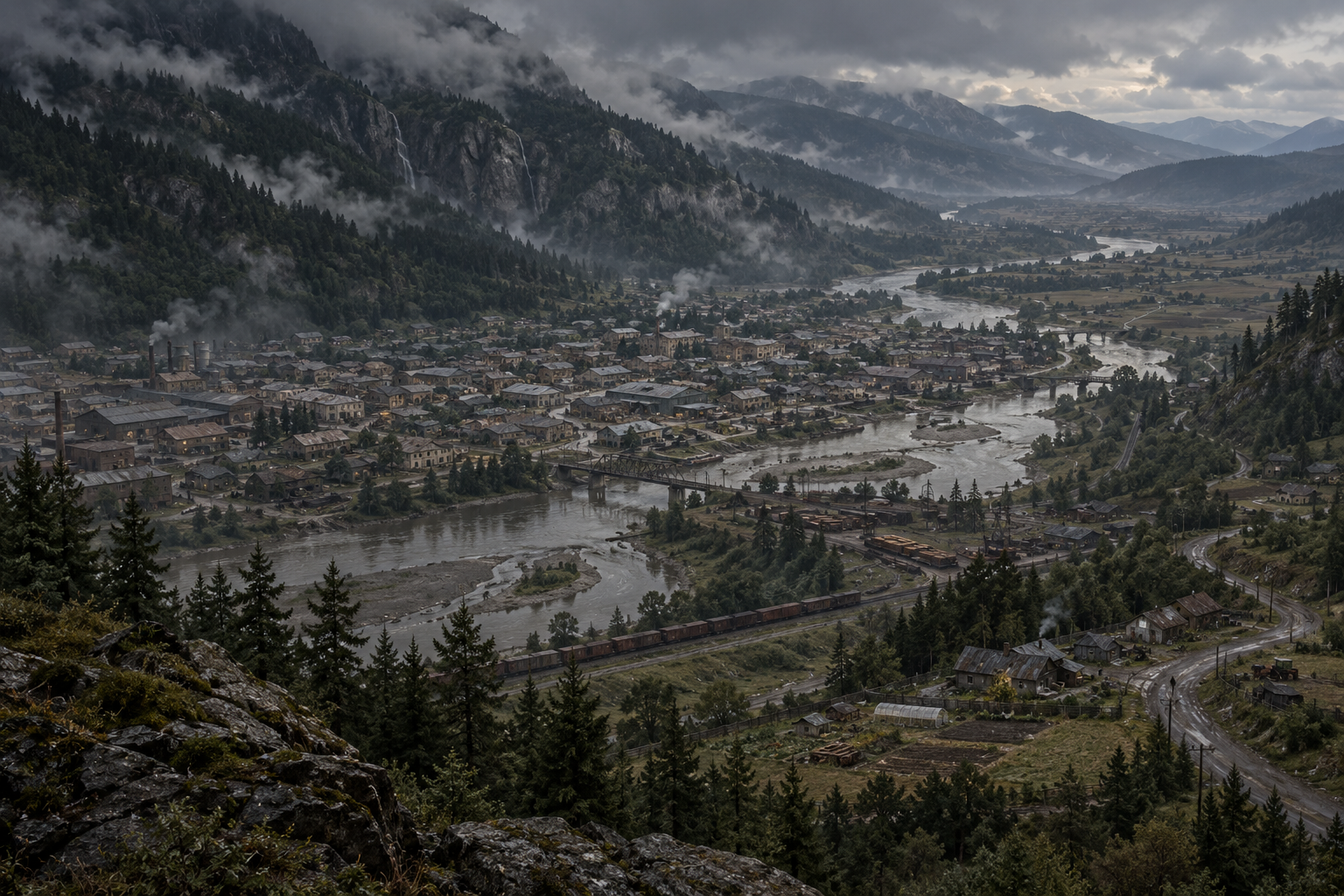
The Merean Sea separates eastern Rauth from the Veydan islands. Their outer shores meet cyclonic weather; enclosed sounds provide anchorage but can trap polluted water. Across the equatorial belt lies Edrava, the southern continent. Orsala occupies part of its western monsoon plain. Its wet season fills rivers that are not ordinary cart roads with water added. Ferries, embanked causeways and raised granaries are distinct infrastructure with distinct owners.
The rest of Tarsenne includes southern cold forest, steppe, salt basins, deserts, high alpine ground, equatorial rain forest, marshes, open grasslands, volcanic islands and polar ice. These environments occupy real distances. A cold pass beyond the Sedge Coast leads to forest and inland routes; it does not deliver a traveller into every climate on the planet. The orientation map locates the principal regions without supplying a navigable road atlas.
The white-edged sailmoth migrates up Rauth’s river valleys as the rains ease. Its larvae strip the river ash, providing food for the needle-beaked shallows birds. Orsalan flood deer browse islands exposed by receding water. Veydan blue-rim oysters filter the sheltered sounds and become unsafe food after certain algal blooms. These are local ecologies, not a universal menu of useful creatures.
Conservation authority is dispersed. Halvyr protects some headwaters through valley law, Veydan closes breeding reefs seasonally and Selnic maintains seed refuges on land too saline for ordinary cropping. Survey records show shrinking low-altitude snow cover in several Rauth catchments over the last forty local years. They do not establish a uniform planetary trend from that one region. Farmers argue about allocation now, while scholars argue about the longer causes.
3. Histories older than the current borders
Human habitation predates the surviving continuous survey calendar. Excavated habitation layers contain domestic ceramics, repair work and adapted organisms, followed in different places by abandonment, reuse and new construction. Older residents are not treated as a vanished people merely because a later arrival wrote a better catalogue. Descent, settlement rights and the meaning of first inhabitant remain locally contested.
SR 0 marks a coastal observatory agreement to preserve a common sequence of seasons and sky records. It is neither the creation of Tarsenne nor the beginning of settlement. Copyists in later centuries extended parts of the chronology backwards using flood deposits and astronomical records. Dates before SR 0 are consequently given as ranges when the evidence permits only ranges.
Off-world contact has waxed and waned. A surviving machine can be older than the dynasty claiming to have brought civilisation with it. The coastal treaty documents show particular exchanges of protection, recognition and access. They do not constitute a deed to the planet. The Orinthian commissioner’s limited remit belongs in that history, alongside independent states which negotiate their own affairs.
| Survey date | Turning point | Extent of the claim |
|---|---|---|
| Before SR 0 | Multiple settlement layers and long-distance coastal trade | Local evidence; no common founder or complete migration history |
| SR 0 | Vannic observatories adopt a shared survey sequence | A dating agreement among participating record keepers |
| SR 214–229 | Broken Winter interruptions to the northern grain routes | A regional sequence of severe seasons and transport failures |
| SR 391 | Merean pilot tables begin regular cross-island collation | Improved shared navigation, not a united island government |
| SR 527 | Sedge Coast landing-rights charter copied into the current coastal register | Basis of some present rights; interpretations and later leases differ |
| SR 683 | Current reference year | Coastal customs petition awaiting its royal hearing |
4. Countries, communities and contested reach
The four principal country dossiers in this instalment cover the Crown of Halvyr, Republic of Selnic, Veydan Concord and Kingdom of Orsala. Together with the Sedge Coast survey district, these profiles cover roughly 15.4 million people. The difference from the planetary estimate includes smaller polities, self-governing towns, mobile communities and districts counted imperfectly or not at all.
A coloured patch on a map indicates a principal area of government and settlement. It does not erase people between patches. Some boundaries follow watersheds; others follow a tax register whose author never walked the watershed. Seasonal pasture agreements and marine passage rights often matter more to an ordinary traveller than the broadest diplomatic claim.
The Sedge Coast is deliberately listed separately from sovereign countries. North Quay governs a port; Reedbank governs its own affairs; six settlements dispute the port’s customs claim. Neither a planetary government nor a common coastal government supersedes those local authorities.
| Country or district | Principal city | Government | Approximate population |
|---|---|---|---|
| Crown of Halvyr | Rimefold | Crown and valley estates | 3.1 million |
| Republic of Selnic | Tessovar | Basin republic | 4.6 million |
| Veydan Concord | Nacre Sound | Seven-state federation | 2.2 million |
| Kingdom of Orsala | Miravel | Monarchy, landed courts and town councils | 5.4 million |
| Sedge Coast survey district | North Quay; no common capital | Independent communities and a port jurisdiction | 74,000 |
5. Trade and the cost of reaching another place
Rauth’s north sends durable timber, worked metal and cold-country fibre south. Selnic buys materials that cannot be made from salt or patience and sells precision ceramics, stored seed and repaired mechanisms. Orsala’s grain and fibre feed coastal markets when the shipping season and prices permit. Veydan carriers move goods between them, competing with mainland owners rather than possessing a monopoly over every boat.
North Quay is the remaining deep-water port serving its immediate coastal region. It is not the only deep-water port on Tarsenne. Reaching another port may require roads, hulls, fuel, papers and money unavailable to a person standing on the wrong bank. A ship advertised in a capital is not thereby within reach of Reedbank.
No planetary currency clears every debt. Weighed silver circulates on the Sedge Coast, country currencies elsewhere, and some long-distance contracts specify metal weight or a deliverable commodity. A family can own useful property while lacking the cash required by a carrier. The trade tables use local units and dates; they do not imply that a low number in one currency makes that country cheap.
Goods move with people whose labour makes the route possible: road gangs, animal handlers, pilots, loaders, cooks, mechanics and guards. A road-building expedition has to be supplied before a new road can supply anyone else. An allied garrison needs transport, permission and a reason to arrive. These material conditions give border politics consequences beyond a map changing colour.
6. Households, languages, learning and care
Survey languages and trade speech overlap with hundreds of local ways of speaking. A merchant may negotiate a cargo in one language and explain a childhood insult in another. National schooling promotes shared scripts without instantly extinguishing household speech. Deaf sign traditions travel with crafts and families; their existence does not depend on a court recognising them.
Settlement registers count people for particular purposes. A school roll misses adults, a water register may miss a mobile household, and a levy roll can count someone who left years ago. Population estimates therefore carry their coverage.
Care varies from city wards with trained surgeons to travelling practitioners and family nursing. Psionic practice and spellcraft sometimes supplement treatment, but neither creates a common supply of sterile materials or abolishes the need to understand a wound. On the Sedge Coast, a well-maintained crossing may improve access to care more reliably than a visiting adept who leaves again.
Children learn through households, lessons, work and play. Some apprentices are paid; some arrangements conceal cheap labour under the promise of learning. A nation’s education law belongs beside the means by which a child actually reaches the school. Citizens in these pages have pleasures and ambitions as well as needs measured by administrators.
7. Belief, art and news on the rim
There is no planetary faith. Ancestor obligations, local spirits, ethical schools, household rituals and organised congregations coexist with scepticism and ordinary inconsistency. People borrow a neighbour’s festival without adopting every doctrine behind it. A traveller can encounter familiar food at an unfamiliar rite and misread both.
Portable art travels especially well: songs, stamped cloth, carved gaming pieces, comic recitations and cheap illustrated sheets. Performances change with their audience. An Orsalan river comedy told in Rimefold often acquires a frozen ferry and a villain unable to dress for the weather. Its author is rarely consulted.
News moves through local radio, cable links, printed gazettes, couriers and ships. Equipment coverage, power and political interference vary. A coastal rumour may reach the next market before a correction reaches the office that printed it. Interstellar correspondence is less regular still. The rim is connected, but connection is an achievement of particular routes and institutions, not a promise of immediate knowledge.
8. Technology, arcane practice and public force
Tarsenne has workshops capable of excellent work beside communities maintaining devices they cannot reproduce. This unevenness results from supply chains, training, power and history. It is not a single ladder on which every society stands one rung below an imperial visitor. An imported vehicle can sit useless while a locally built ferry keeps operating.
Psionic adepts work through disciplined attention and Psionic Aether; spell practitioners depend on learned workings, preparation and, for some tasks, appropriate materials. Schools dispute theories. Competence has a scope. A person who can hold a brief stabilising field has not thereby learned to diagnose a disease, navigate a ship or read a stranger’s intentions. Training, access and consent are subjects of country law and local custom.
Country forces defend different interests. A valley muster, harbour flotilla, basin road guard and royal field force need different equipment and support. Private security exists as well. An armed contractor’s contract is not the same thing as public authority. Captured territory brings hungry residents, damaged works, contested property and an obligation to govern, if the conqueror intends to remain.
Observatories and a small number of maintained aerial and orbital facilities support surveys and limited contact. Their owners sell access on terms. This is not a scheduled planetary passenger network, and no government here has an unlimited fleet waiting just off the map.
9. Rest days, games and journeys made for pleasure
People travel for fairs, matches, weddings, instruction, pilgrimage, visits and the desire to see somewhere else. Halvyri winter games and Orsalan flood-season entertainments need not be understood through war. Veydan regattas include working crews and expensive vessels; Selnic public gardens are places to court someone, quarrel quietly or sit without buying anything.
The Crossings Circuit is a loose arrangement among hosts of boat races, stone-board tournaments and travelling performances. It has no supreme committee or universal medal table. Each host publishes its rules, entry costs and prizes. Some residents regard visitors as welcome customers; others would like their road back. The same person may hold both opinions before supper.
10. Reference epoch, register and reading routes
This instalment records the world before the princess’s voyage. Country year reviews describe completed events from SR 682 and conditions observed at the opening of SR 683.
For a journey outward from the Sedge Coast, read the Sedge Coast dossier, North Quay and Reedbank, then the northern and inland countries. For a comparison of institutions, place Halvyr’s succession beside Selnic’s elections, Veydan’s federal bargains and Orsala’s divided authorities. For lived consequences, begin with Istra’s repair bench and follow the materials she needs.
The city plans show selected principal streets and useful public destinations. Numbered landmarks correspond to the written directories; the plans do not catalogue every alley, boundary or household.
Physical and orbital register
Standard days contain twenty-four standard hours. Rotation periods describe the local solar day at the precision used here; rounded orbital figures are reference values. Population estimates count inhabitants, including municipal populations listed separately elsewhere. They do not count every inhabitant as a subject of one crown.
Aunel is the local star. Tarsenne is a rim world in the galactic Outer Rim, commonly the rim; it is not at the edge of its own solar system. Orris is its principal visible moon. The Mercator chart enlarges high latitudes and generalises coastlines, so apparent size on the page must not be used to compare areas.
| Measure | Reference value |
|---|---|
| Primary / orbital distance | Aunel / approximately 1.023 AU |
| Primary mass / luminosity | 0.94 / 0.88 of the standard solar values |
| Mean diameter / surface gravity | 12,560 km / 0.96 standard g |
| Rotation / local year | 26 standard hours / 360 local days |
| Standard-hour year | 9,360 standard hours, equivalent to 390 standard days |
| Axial tilt / water | Approximately 24° / 69% ocean |
| Resident estimate | 19–24 million across the world; uneven census coverage |
| Reference epoch | Opening SR 683; completed-year accounts SR 682 |
| World chart | Spherical Mercator, cut at 80° north and south; the prime meridian passes through Old Vannic |