Orsala · monsoon plain
Zoom, pan, search named places and follow links between maps.
1. Identity and quick reference
Orsala occupies the western monsoon plain of Edrava, Tarsenne’s southern continent. Its principal settled belt lies around twelve degrees south. The court traces the name to an older expression meaning land held in trust. Tenants sometimes shorten the translation to land held, which is usually enough to establish the direction of the conversation.
The kingdom’s emblem is a red seed pod beneath three silver drops on a green field. The pod is drawn closed: it signifies what must be preserved for another season, rather than an assurance of present plenty. Queen Anessa Talun reigns from Miravel. The town councils and landed courts exercise powers that predate parts of the modern crown, and royal officers must work through those arrangements.
A household may celebrate Anessa’s accession day and appeal against her tax officer. Others prefer a competent ferry inspector to another argument about national character. Loyalty is not a single opinion shared throughout the kingdom.
The royal motto, Keep the Next Season, appears on the seed-pod seal used for crown instruments. Towns countersign matters within their own powers rather than borrowing that seal. The anthem Rain on the Roof began as a court setting of a much older work song; village versions often omit its verse praising the dynasty. The Town Compact anniversary and the sovereign’s accession observance close national offices. First Rain remains locally dated, and agricultural work cannot always stop with the musicians.
| Reference | SR 683 working entry |
|---|---|
| Government | Hereditary crown sharing authority with landed courts and elected town councils |
| Capital | Miravel, on the western bank of the Ildren |
| Population | About 5.4 million; district registers supplemented by settlement estimates |
| Land area | About 2.1 million km²; includes sparsely inhabited uplands and seasonal grazing districts |
| Sovereign and designated heir | Queen Anessa Talun; Princess Vesari Talun |
| Currency | Tal, divided into one hundred fen |
| Climate frame | Southern-hemisphere monsoon regions; local wet and dry cycles vary |
2. Geography, climate and living environment
Orsala’s western lowlands receive seasonal ocean moisture. Inland terraces and broken uplands vary the pattern; the country is not one continuous paddy field. Cultivation includes reed-rice, pulses, orchard fruit and fibre crops. Higher districts keep livestock and manage timber, while coastal communities combine salt works, fishing and market gardening. The Ildren drains towards the south through the capital region. Its broad floodplain is valuable partly because it is periodically unsafe.
Monsoon preparation is a household activity as much as a state operation. Roof ties, raised cupboards, clean storage vessels and documents kept above the expected water line are familiar investments. River households watch rain reports from upstream rather than relying on the sky directly over their own roof. Seasons here are reversed relative to the northern temperate mainland, although a calendar quarter does not predict a particular storm.
Miravel stands on the Ildren’s western bank, with higher residential ground farther west. The eastern meadows take seasonal floodwater and support grazing, reeds and temporary fairs when conditions allow. They are not an empty site awaiting a palace. Restricting permanent building there protects the river’s capacity but can displace people who already depend on seasonal work.
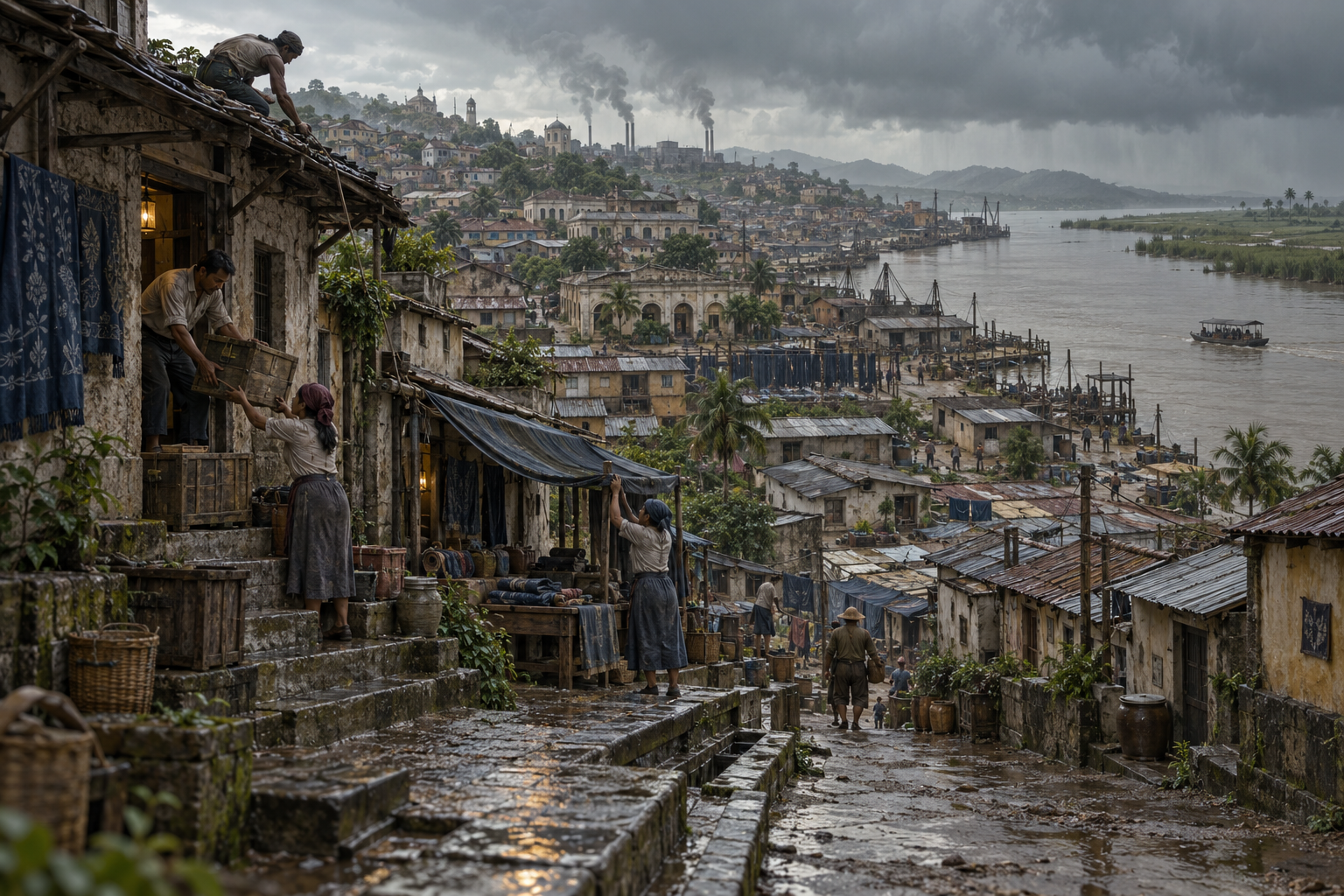
Heat, standing water, erosion and interrupted roads require different preparations. Good drainage helps; neither an expensive house nor an accustomed household is invulnerable.
Ildren reedbeds shelter the small bronze-throated rail, whose nest is built to rise with modest changes in water level. Flood deer browse temporary islands after the river withdraws. Terrace farmers plant red-pod shade trees along boundaries, valuing their roots and arguing about the shade they cast. Belsa’s upper forest reserves protect catchments used downstream, while upland households demand payment for restrictions benefiting distant estates. Visitors may enter designated forest walks; collecting medicinal bark requires the landholder’s agreement and seasonal limits.
3. History, memory and the principal instruments
The River Oath of SR 252 joined the Talun household and several lower-plain estates in a common defence and grain-store undertaking. It recognised a crown without erasing the landed courts through which many communities already settled property disputes. Palace genealogies reach farther back; the oath is the earliest surviving document that clearly describes a kingdom recognisable in current institutions.
The Landed Articles of SR 311 fixed obligations for channels, roads and military levies. They protected some cultivators from arbitrary demands and strengthened landholders able to prove recognised status. People without a recorded holding appear chiefly as workers and dependants. Later historians have recovered their lives from wage books, household testimony and complaints written in the margins of official returns.
Consecutive crop failures and disrupted transport produced the Scarcity Years of SR 462–465. The crown requisitioned stores, and several estate courts withheld grain while arguing that their local obligations came first. Some decisions protected villages; others protected profitable contracts. The subsequent Relief Articles limited seizure powers and required recorded compensation claims. Many payments arrived late, and not all arrived.
The Town Compact of SR 601 strengthened incorporated towns’ authority over extraordinary revenue and public works. Rural obligations persisted. Current disputes invoke all four instruments, each with particular parties, territory and limits.
4. Crown, courts, councils and politics
Queen Anessa appoints ministers and negotiates external agreements, while extraordinary levies require the assent of the Landed Chamber and the Council of Towns. Ordinary revenue follows standing schedules that both bodies can challenge through defined procedures. The Landed Chamber represents recognised estates, including communal holdings, with unequal influence. Town councils are elected by adult registered residents; proving residence remains harder for seasonal workers than the formal rule suggests.
Succession normally passes to the sovereign’s eldest eligible child. The heir’s declaration must be entered before both chambers, which can challenge specified incapacity or an incompatible foreign obligation through the Crown Bench. They cannot simply hold an election for somebody they prefer. Princess Vesari is Anessa’s designated heir. Younger branches retain claims under the published order; no royal marriage automatically transfers the country to a foreign crown.
Landed courts hear tenure cases; town courts handle municipal disputes; the Crown Bench receives qualifying appeals. A successful tenant still needs resources to enforce judgment. Conversely, an elected council can mistreat an unpopular trader.
Orsala’s current divisions concern flood works, tenant representation and the distribution of transport grants. Ministers seek agreement with people who can delay implementation after losing a vote.
| Administrative district | Principal character | A recurring dispute |
|---|---|---|
| Ildren Crownlands | Miravel and the middle river estates | Shared costs of urban flood protection |
| Hadrin Plain | Rice and pulse cultivation | Tenancy terms and seasonal labour |
| Belsa Uplands | Timber, orchards and livestock | Forest access and downstream erosion |
| Namar Coast | Salt, fishing and coastal towns | Storm shelters and commercial berths |
| Tolset Reaches | Northern channels and market settlements | Allocation during low water |
| Arut Vale | Eastern terraces and mixed holdings | Representation of communal land courts |
5. Economy, labour, finance and trade
Agriculture employs many households without exhausting the economy. Orsala produces woven fibre, pigments, preserved foods, pumps, building tile and river craft. Miravel and the larger towns support engineering workshops, book production, clinical training and legal services. Coastal traders exchange goods with Veydan and Rauth; some contracts continue across the rim through intermediaries and infrequent interstellar shipments. A domestic river manifest should not be mistaken for a spaceflight timetable.
The tal is issued by the Royal Mint under audited metal and reserve rules; town clearing houses also transfer accounts without handling coin. Foreign silver is accepted by agreement and weight, not as a universal unit. Agricultural credit can bridge a planting season or bind a family to an unattractive buyer. Relief lenders, estate advances and private banks have different terms, and the cheapest printed rate may carry the most restrictive sale obligation.
Wage work follows crop, construction and transport cycles. Guilds negotiate standards in several trades; seasonal workers often organise through lodging yards and village networks instead. Apprentices’ paid hours and household labour matter alongside formal wages.
One Miravel household’s account for the twelfth numbered month of SR 682 records 96 tal from parcel-office work, washing contracts and herb sales. The table covers thirty local days. It is a case record, neither a median income nor a measure of the kingdom’s prosperity.
| Use by the Meval household | Tal in the recorded month |
|---|---|
| Rent | 18 |
| Food | 31 |
| Fuel, water and waste collection | 9 |
| Local travel | 5 |
| School materials | 3 |
| Support sent to a grandmother | 8 |
| Care reserve | 5 |
| Debt instalment | 8 |
| Remaining household reserve | 9 |
6. People, learning, care and support
Population returns combine towns, estates, villages and estimated mobile communities. Their uneven coverage cannot justify precise national life-expectancy, literacy or income-distribution figures.
Orsalan Common is used for much national administration, while valley and coastal languages remain ordinary languages of home, worship and local business. Courts must provide interpretation when a party cannot understand proceedings. Funding and availability make that duty uneven. Schools use different combinations of local language and Common; older pupils can train through colleges, apprenticeships and agricultural field stations.
Public clinics concentrate on childbirth, infection, injury and illnesses worsened by water or heat. Hospitals receive district referrals. Their ability to help depends on transport, trained staff and supplies; a road closure can undo an excellent appointment system. Healers practising spellcraft work within specified capabilities and consent rules. No public service promises that mana will mend every body.
Town care funds offer limited support; landed communities may owe grain or service instead. Separated households and migrants often struggle between jurisdictions. Scarce accessible housing and schools force difficult choices about distance, cost and companionship.
7. Culture, belief, arts and public speech
The Keeping of the Seed is a widespread family of beliefs about stewardship, return and obligations to future households. Some temples maintain seed stores as a sacred duty; others concentrate on teaching or care. The Still-House tradition values quiet recitation and rejects hereditary religious office. Shrine communities honour particular rivers, predecessors or places, while secular households participate in public observances for reasons that need no doctrinal explanation.
Anessa attends major observances without certifying a single theology. Ministers may claim ancient unity; market conversations readily disprove it. Mixed families negotiate meals, funerals and children’s participation alongside their other shared responsibilities.
Orsalan arts include resist-dyed cloth, fitted wooden screens, long-form sung argument and shadow plays whose visible operators can interrupt their own characters. Court companies travel with elaborate scenery. Smaller companies can fit a complete domestic catastrophe into a courtyard, three lamps and an exceptionally well-painted door. The audience recognises the landlord before he speaks.
Radio, local journals, public reading rooms and carried letters support lively argument. Printing licences regulate ownership and libel liability rather than every sentence, but officials can still misuse the rules. Flood warnings have designated channels separate from commentary. A preacher, journalist or performer may dispute a minister’s intentions; none is authorised to invent a safe river level.
Essayist Teluna Vash wrote The Uninvited Chair after years recording town hearings. Each essay follows a person affected by a decision who was not present when it was made: a washerwoman, a tenant’s child, a ferryman’s widow. The book circulates in temple libraries and municipal reading yards. Its admirers disagree thoroughly about which present officials ought to be forced to read it.
8. Knowledge, public works, arcane practice and defence
The Miravel Hydraulic College trains surveyors and maintains upstream observation agreements. Its laboratories study sediment, materials and pump efficiency. Agricultural stations compare crop varieties under recorded conditions; the failed trials are supposed to remain in the archive. Contractors sometimes prefer results from an unusually agreeable season, which is one reason public specifications require several kinds of evidence.
Electricity combines regional generation with town grids and local reserves. Rail and surfaced roads connect major centres, while boats remain essential for particular loads and seasons. Drinking-water intakes are separated from waste outfalls; maintaining that separation takes money and enforcement. Town engineers can close unsafe structures, including property with a noble crest above its gate. Whether they receive immediate support is another matter.
Psionic schools teach disciplined practice with limits on focus, mental strain and reliability. Paid practitioners must state what service they can actually provide. A court may accept a documented observation but cannot treat a claimed impression of dishonesty as demonstrated guilt. Spellcraft uses mana, trained patterns and appropriate materials. Medical or structural applications require relevant supervision; ordinary household workings are not evidence of citizenship or loyalty.
The royal army, district levies and river guard have separate responsibilities under common mobilisation rules. Defence expenditure competes with water works without making either optional. Coast batteries and patrol craft protect particular approaches. Orsala claims no authority over Tarsenne’s other sovereign countries or the independent Sedge Coast communities.
The kingdom supplies selected Orinthian military and civilian contracts without ceding its factories. Food and clinical reserve floors limit exports; a purchaser cannot buy the last district stock by offering a royal seal. Freight booked through Namar’s coastal brokers still waits for actual onward passage.
| Centre | Product | Inputs | Route | Buyers and sovereignty | Bottleneck |
|---|---|---|---|---|---|
| Tolset Culture House | Medicinal fermentation products under clinical specifications | Clean cultures, sugars, sterile vessels | Cold freight through Miravel to Namar | Domestic clinics and limited Orinthian medical contracts; Orsalan ownership | Culture integrity and refrigeration |
| Hadrin Cooperative Mills | Technical fibres and field dressings | Fibre crops, clean water, sterilisation equipment | River freight via Miravel and Namar | Civilian hospitals and contracted military buyers | Validated sterile packing and seasonal crop quality |
| Miravel Reserve Granaries | Preserved food consignments | Recorded harvests, containers, inspected stores | River and coastal freight to booked exports | Domestic reserve first; surplus under sovereign export permits | Flood losses, reserve floors and ship space |
9. Games, sport, recreation and time away
Pole-course races use narrow unpowered boats in marked shallow reaches. Crews negotiate gates under rules rewarding control. Young competitors train separately. River officers cancel unsafe events regardless of how many programmes the organisers have printed.
Dry-ground sports include a court game called span, in which teams send a cloth ball across a low net using small wooden frames. It can be played seriously in a town enclosure or approximately behind a workshop. Upland walking, wrestling clubs, kite making and indoor board games have enthusiastic followings. Disability clubs adapt equipment and compete on agreed terms; access to facilities remains a practical campaign.
Miravel’s evening reading yards and river walks are popular when the air cools. Families picnic on permitted western terraces; eastern meadow visits depend on water notices and the return ferry. Musicians perform for paid admission, voluntary contributions or the pleasure of being heard by somebody other than the household.
The First Rain observance follows a local seasonal threshold, independently of northern quarter festivals. Food, music and repairs accompany arguments about whether a shower was sufficient. Those working through the celebration remain part of its history.
10. SR 683 review, tables and directory
This pre-departure SR 683 review uses district rolls, court registers, town accounts and inspection summaries. Rounded estimates do not imply precise comparisons; the household budget covers one identified month in local currency.
At present, the chambers are examining a revised contribution schedule for flood works, a proposal to allow seasonal workers longer registration windows, and disclosure requirements for crop advances. The queen supports the works schedule while several rural courts dispute its allocation. Town reformers disagree among themselves about who should pay for improved registration.
Records are available through Miravel’s Rain Archive and district repositories. Councils post meetings and charges; the Crown Bench publishes appeal requirements. River-guard notices govern meadow access. Private debts and family invitations do not suspend landing closures.
The map distinguishes high ground, working riverbank and eastern flood meadow. Dry ground is not automatically a development right.
Completed SR 682 brought the reopening of a Tolset cold store with independent reserve power, new evening classrooms in two Hadrin mill towns, and a Namar agreement to publish berth charges at the landing. The cold store reduced some spoilage without removing the need for a refrigerated onward journey. The flood-contribution and residence proposals remain unresolved at the opening of SR 683.
An account older than the crop
The Relief Articles followed the Scarcity Years because requisition and protection could look identical from the road: armed men arriving for a granary's contents. The difference lay in authority, limits and compensation that might never reach the household entitled to it. District archives retain rejected claims as well as paid ones. Descendants consult them over land and inheritance, not merely to furnish speeches about national resilience.
After the Town Compact of SR 601, incorporated towns gained stronger bargaining power over extraordinary revenue and works. Rural labourers were not thereby given a town voice. An estate could celebrate the compact while continuing to demand services under an older obligation. Present disputes over flood contributions therefore turn on which body can commit whose labour, and whether those made to provide it receive any say in the undertaking.
The advance with a pleasant name
Crop advances link a lender to a grower's future harvest. Some provide useful credit on disclosed terms; others require delivery to a favoured buyer at a price settled before the household knows what its crop will cost. Calling the arrangement seasonal assistance does not alter its arithmetic. Rent, seed, funeral expenses and last year's poor yield can leave a working family with almost no unpledged output.
Tenant representative Malessa Dorr organises copying sessions beside Hadrin's mill-town evening classrooms. Participants bring contracts, witnessed oral terms and accounts of deductions. She does not promise that every obligation can be struck out; she helps people distinguish a lawful claim from a creditor's invention. Landed courts can order a remedy, while an estate controlling transport or storage can make enforcing it expensive. Town reformers consequently seek disclosed charges as well as better hearings.
A sterile dressing begins far from the wound
Hadrin technical fibres need clean processing water, suitable crop material and validated packing. Tolset medicinal fermentation requires stable cultures and vessels that stay clean through repeated use. These are controlled workplaces even when the road outside is muddy. A stained loading yard and a contaminated sterile room represent different problems, and only one can be accepted as ordinary wet-season inconvenience.
Cold freight travels through Miravel towards Namar under actual temperature and handling requirements. A reserve floor protects domestic need, but maintaining it costs refrigeration, inspection and replacement stock. Merchants sometimes demand compensation for holding goods that cannot yet be exported. The treasury then pays to keep medicine at home while being criticised for failing to earn foreign money from it, an achievement more readily accomplished in a speech than a ledger.
| District and work | Necessary input | Exposure beyond the workplace |
|---|---|---|
| Hadrin mills and field dressings | Suitable fibre, clean water and sterile packing | Seasonal housing and the cost of interrupted work |
| Tolset cultures and clinical products | Clean cultures, reserve power and cold transport | District treatment delayed by a broken chain |
| Belsa timber and catchment care | Regrowth, protected slopes and skilled cutting | Downstream sediment and disputes over restrictions |
| Namar export handling | Booked berths, inspected stores and onward capacity | Storage charges and local demand competing for space |
Rain enters the house by several doors
Flood water brings obvious damage; humidity brings slower losses. Veil-mould grows behind stored woven screens and beneath poorly dried bedding, producing fine irritant dust when disturbed. Household drying racks and ventilation take space. Landlords who subdivide a ventilated room into several dark cubicles increase income while distributing the later medical costs among their tenants.
Ildren reedbeds support mud shears, long-bodied reptiles that hunt fish along inundated banks. They generally withdraw from groups but defend nests and trapped feeding pools. River-guard notices identify affected approaches; people use raised paths and keep children away from apparently stranded animals. In Belsa, bitter-root creepers bind disturbed soil but can make grazing animals ill. Field schools teach their identification alongside useful medicinal plants, which is less romantic than gathering a miraculous cure and rather more reliable.
Institutions between the district and the Crown
Flood works require surveyors, maintenance workers, clear access and a route for complaints from those whose land receives displaced water. The Hydraulic College compares upstream observations with conditions downstream. A model's success in an average season does not protect the house left outside its surveyed boundary. Town engineers can close unsafe property, while the Crown's willingness to support the closure determines whether the rule survives an influential owner's displeasure.
Royal troops, district levies and river guards share mobilisation requirements but do not perform interchangeable work. A levy call can leave fewer hands to inspect channels; an evacuation can deprive a mill of its experienced operators. Clinical and engineering personnel need protection without being treated as inexhaustible labour. Psionicists must describe the service they provide, and spellworkers must retain consent, supervision and ordinary evidence when their work concerns bodies or structures.
The season people try to keep
Keeping of the Seed temples distribute planting material under their own obligations; some require repayment, others a later contribution when possible. Still-House teachers challenge hereditary religious office while relying on neighbours for food and repairs. A household can respect both traditions and resent the visiting relative determined to settle their theology before breakfast.
Rice cakes, pulse stews, sour fruit condiments and preserved river fish accompany festivals and ordinary work. Span clubs mend frames with borrowed tools; pole-course crews practise where notices permit rather than treating a ceremonial date as proof of safe water. Teluna Vash's essays circulate beside romances, comic shadow plays and practical crop books. Readers may recognise an excluded neighbour in her Uninvited Chair and still need that neighbour to lend a ladder.